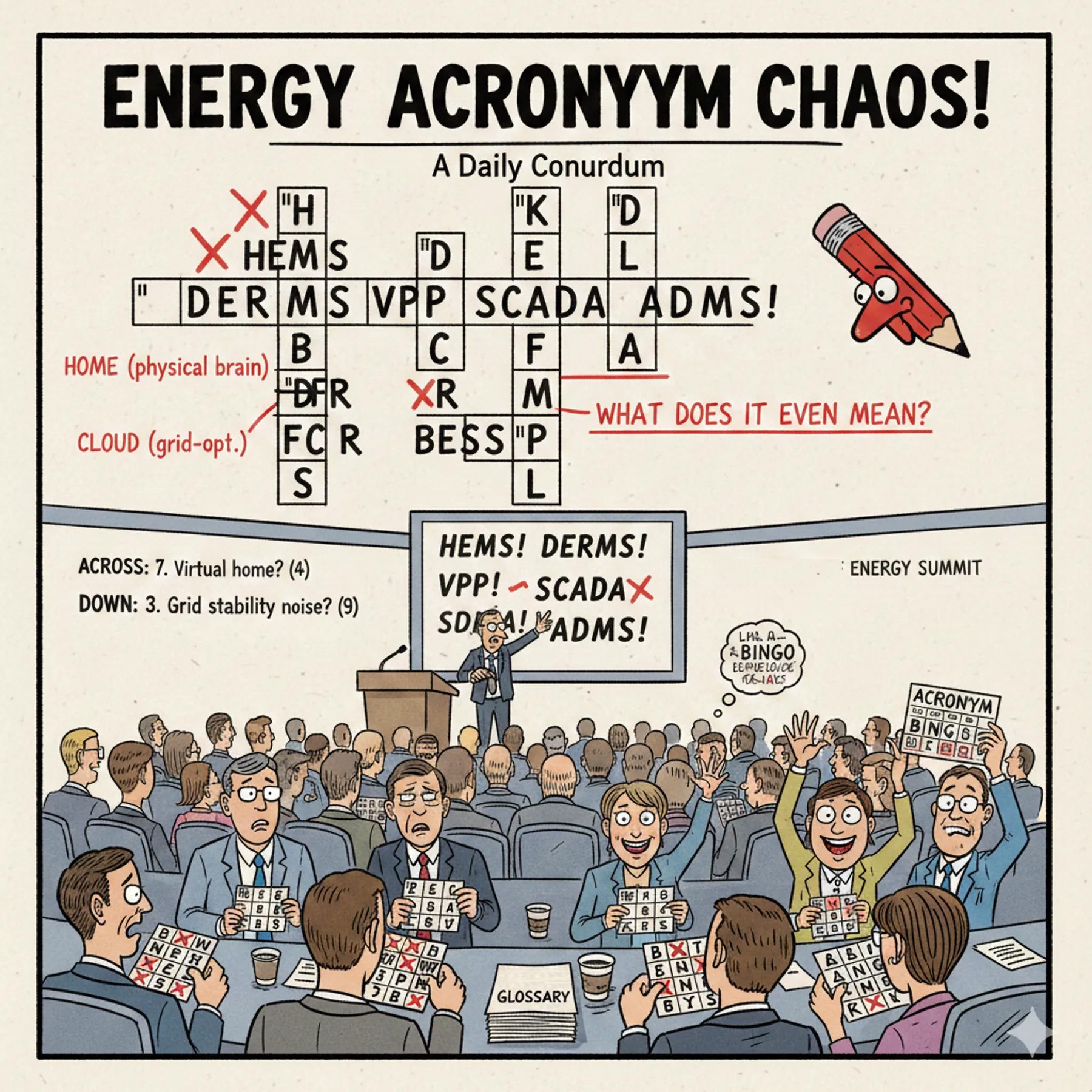
Acronyms are supposed to simplify complex ideas, but in energy they sometimes seem to do the opposite.
I’ve been at numerous events in our industry where speakers (including myself) reference, or joke about, the growing number of acronyms. Acronym bingo, as it’s sometimes called. It usually gets a laugh, but it also hints at something deeper.
Here’s a recent example that’s left me both confused and intrigued, particularly in the developing space of home energy load orchestration and management.
For years, HEMS meant something pretty specific to me: a Home Energy Management System... Physical. In the home. A brain of sorts. A brain, in theory, juggling EV charging, solar, batteries, heating and cooling so the customer doesn’t have to think about it.
That definition worked because it was logical and ring-fenced. You knew where it lived, what it touched, and who it was optimising for.
Lately though, especially in Europe (and I’m not entirely sure why), I’ve seen HEMS start to drift. The same acronym is now being used to describe cloud platforms coordinating thousands of homes, integrated directly with utilities, and optimising for grid outcomes rather than household ones.
At that point, I find myself pausing and asking whether this is still a HEMS, or whether we’re starting to use the term more broadly than we used to.
We then hear phrases like “Virtual HEMS”, which is interesting in its own right. If a system is virtual, not physically in the home, orchestrating fleets of devices, and interfacing directly with utilities, it begins to overlap with what many would traditionally describe as a grid-edge DERMS, just expressed in more familiar language.
That ambiguity of definitions isn’t unique to HEMS.
We see something similar with VPPs (which I’d argue could, in some interpretations, be considered a form of virtual HEMS). Personally, I don’t think the term has been particularly helpful. People use it with very different assumptions in mind, and I suspect many of us are often talking past each other without realising it.
I’m going to park VPPs for now, as that probably deserves its own article.
The broader pattern, however, is consistent.
As we move up the stack into generation and larger sites, acronym density increases quickly. SCADA, EMS, BESS controllers, DERMS, and ADMS all start to appear, sometimes alongside one another. Each exists for a good reason. Each evolved to solve a specific problem at a specific point in time.
Over time though, the boundaries between them blur, particularly as optimisation, visibility, and market participation move closer to real-time operation.
On paper, architecture diagrams look clean. In reality, responsibility is often split across software, contracts, and operating teams, with each system owning part of the truth but rarely the whole picture.
Then we get to transmission and distribution programmes and services designed to help balance the grid:
DR, DFR, FFR, FCR, FCAS, DC, FRR, aFRR, mFRR, EFR, Reg-Up, Reg-Down.
Acronyms multiply, and with them, assumptions. Each label sounds precise, yet hides very different response requirements, penalties, economics, and operational risk.
I’m not arguing that we should get rid of acronyms. We need shorthand. We need shared language. But we do need to be more honest about what those terms hide, and more deliberate about how we use them.
Maybe what the industry really needs isn’t another framework or standard, but a shared, plain-English dictionary. One that says what an acronym usually means, what it definitely does not mean, and where confusion tends to start.
So here’s a small contribution in that direction.
If you want a working definition of how I’m using these terms, see below..
Note: This glossary isn’t intended to be exhaustive or authoritative. It’s a plain-English snapshot of how the acronyms used in this blog are commonly understood, and where confusion often creeps in.
A Plain-English Glossary of Energy Acronyms
HEMS
Originally meant: Home Energy Management System operating locally in the home.
Often means now: Cloud-based orchestration of many homes for grid outcomes.
Why it causes confusion: Household optimisation and fleet-level coordination are very different responsibilities.
Virtual HEMS
Sounds like: A HEMS that lives in the cloud.
Usually is: Utility-integrated orchestration of residential DERs.
Why it causes confusion: Once it’s virtual and grid-facing, the “home” part becomes less clear.
DER
Means: Small, distributed assets that generate, store, or shift electricity.
Why it causes confusion: Used for individual devices and entire portfolios interchangeably.
DERMS
Means: Software coordinating DERs to meet grid or market objectives.
Why it causes confusion: Can imply monitoring, optimisation, control, settlement, or all of the above.
Grid-edge DERMS
Usually means: DERMS focused on behind-the-meter or residential assets.
Why it causes confusion: Adds specificity without clearly redefining scope or responsibility.
VPP
Means in theory: Aggregated DERs behaving like a single resource.
Why it causes confusion: Different people mean very different things when they use it.
SCADA
Means: Industrial systems for monitoring and controlling physical infrastructure.
Why it causes confusion: Increasing overlap with EMS and asset-level controls.
EMS
Means: Energy optimisation at a site or portfolio level.
Why it causes confusion: Exists inside batteries, buildings, and platforms under the same label.
BESS
Means: Battery, inverter, controls, and enclosure as one system.
Why it causes confusion: Often includes its own optimiser that may conflict with higher layers.
ADMS
Means: Advanced Distribution Management System for operating the distribution grid.
Why it causes confusion: Often conflated with DERMS despite serving different operational roles.
DR
Means: Demand Response.
Why it causes confusion: Covers everything from static programmes to near real-time dispatch.
Ancillary Services
Means: Services that support grid stability beyond energy delivery.
Why it causes confusion: An umbrella term hiding very different technical and commercial realities.
DFR / FFR / FCR / FCAS / DC / FRR / aFRR / mFRR / EFR / Reg-Up / Reg-Down
Mean: Various frequency, reserve, and regulation services across markets.
Why they cause confusion: Similar labels, very different activation rules, penalties, and risk profiles.