Heat Pumps Changed How I Think About Home Heating: From UK Boiler Panic to US Climate Control
A broken boiler in the UK led to a quick decision. Living with a heat pump in the US completely changed how I think about heating, comfort, and what a home should feel like.
Around a year ago I had the classic boiler failure on a cold day. No warning, no heat, and a quick decision to make.
Repair or replace.
The answer was a few thousand pounds for a new gas boiler, and it needed doing immediately.
Heat pumps came up, but the reality felt impractical. Retrofitting a 100 year old semi detached house, lifting floors, reworking pipework, and still ending up heating through radiators felt like a lot of cost and disruption for an uncertain outcome.
So I replaced the boiler and moved on. At the time, it felt completely logical.
Heat Pumps in the US: Why They Are So Common in Southern States
In the US, I walked into something very different.
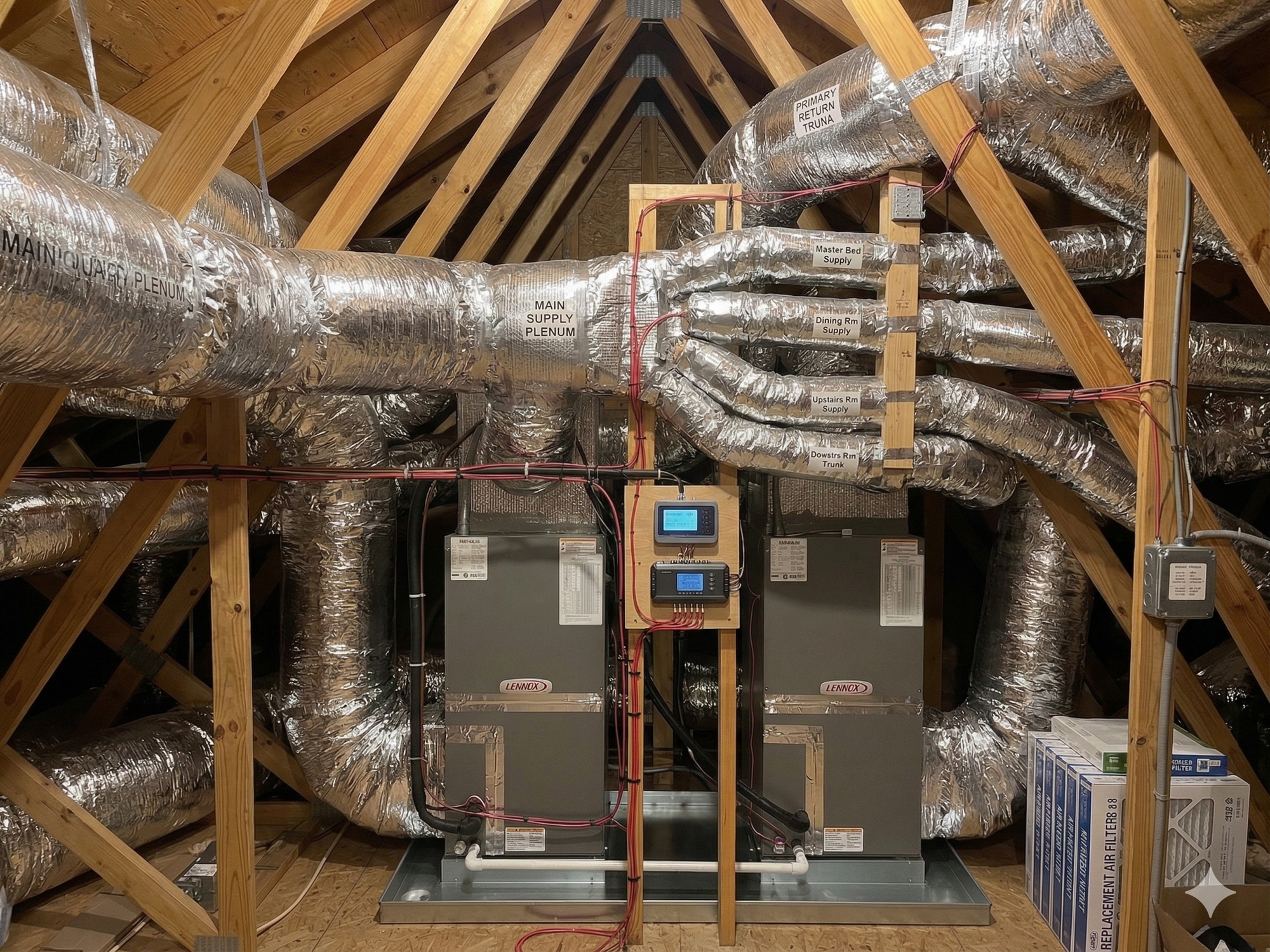
Two fairly unattractive units outside and, in the attic, a Tardis of aluminium ducting that looked like it had been lifted straight out of a 1970s sci-fi film. At first glance, it felt dated.
It turns out I had completely misread it.
What I actually had was a system that heats and cools the entire home through vents. No radiators, no hot spots, and no need to think about when it comes on. Just a steady, controlled indoor climate.
What I did not realise at first is that this is not new or niche.
Heat pumps have been standard across the southern United States for decades. Around 40 to 50 percent of homes in the South use heat pumps, with even higher penetration in some states¹. This is largely because the climate suits them and homes are designed around ducted airflow.
This is not an emerging technology here. It is simply how homes work.
Radiators vs Air Systems: Why Heat Distribution Feels Completely Different
Heating in the UK often feels like something happening in parts of a house rather than across it. A radiator under a window, one tucked behind a sofa, maybe a slight draft coming through the frame, all trying to control the comfort of an entire living room with multiple people in it.
This feels completely different. It is not fighting the room, it is managing it.
The temperature is consistent across the entire home. It is not warmer near a radiator or colder in the corners, but genuinely even. It becomes less about heating and more about climate control.
The closest way to describe it is a constant, ambient environment. Almost like a warm or cool “hug” rather than bursts of heat.
It is subtle, but once you experience it, it is very hard to go back.
Why You Stop Thinking About Heating with a Heat Pump
One of the strangest changes is how little you think about it.
There is no planning when the heating comes on, no boosting it before bed, and no hoping the room warms up quickly enough. The system simply maintains temperature through airflow across the house.
Over time, you stop managing heating altogether and just live in the environment it creates.
Indoor Climate Control vs Weather Awareness
In the UK, even indoors, you still feel connected to the outside temperature. Cold days feel cold and warm days feel different as the house reacts around you.
With this system, that link almost disappears.
Inside becomes consistent, with the house maintaining its own environment regardless of what is happening outside. Although I have fallen foul of seeing blue skies and assuming it is a shorts kind of day, which is probably more to do with being a Brit learning a new climate. Still, it shows just how disconnected the indoor environment becomes.
It is a small shift, but it meaningfully changes how the home feels to live in.
Heat Pump Retrofit Challenges in the UK Housing Stock
None of this removes the reality of retrofit.
The concerns I had at the time still stand. Cost remains high, installation can be disruptive, and older housing stock is harder to adapt. Even when installed, radiator based systems do not fully deliver the same experience.
So this is not a simple switch for existing homes.
Future Homes Standard UK: Will New Builds Move Beyond Radiators?
Where this really clicked for me is when thinking about new builds.
A home designed with ducted airflow, even temperature distribution, and integrated heating and cooling does provide a more consistent and controllable indoor environment. It is not just about efficiency, but about comfort and how evenly that comfort is delivered.
In the UK, new building regulations are already pushing homes in this direction. The Future Homes Standard is expected to phase out gas boilers in new builds and shift toward low carbon heating systems such as heat pumps². However, most UK homes will still use water based systems like radiators or underfloor heating rather than full ducted airflow.
If UK homes begin to adopt more integrated, whole home climate systems over time, particularly in new builds, it will feel like a step change rather than a marginal improvement.
Final Thoughts: Heat Pumps Are About Comfort, Not Just Efficiency
I used to think of heat pumps as a trade off, something that came with more effort, higher cost, and added complexity.
Now I see them differently.
It is not just about how you heat a home, but about how a home feels to live in. And once you experience that difference, it becomes very difficult to ignore.
I moved to the U.S. and became obsessed with water towers. It turns out these quirky town icons quietly shift up to 30 GWh of load every day. No lithium. No algorithms. Just gravity doing the work.