

The Baghdad Battery: Ancient Power or Modern Myth?
Did you know the first battery could be over 2,000 years old? Hidden in the sands near Baghdad, this ancient clay jar may have carried the world’s first spark of electricity.

Opportunity rarely comes from our closest circle. Research and history show that weak ties, the light connections at the edges of our networks, often open the biggest doors. From job markets to civil rights movements, networks quietly shape the world around us.

We often imagine that progress in our lives flows from the people closest to us. Our inner circles feel like the engines of trust, guidance, and opportunity. Yet the patterns of human networks reveal something far less intuitive. Many of the most significant moments in our personal and professional lives originate not from our strongest relationships but from the lighter, occasional connections that sit at the edges of our social world.
This insight first took shape in the early 1970s when sociologist Mark Granovetter published The Strength of Weak Ties r¹. Studying job mobility in Boston, he discovered that people were far more likely to hear about new opportunities through acquaintances than through close friends. Strong ties tend to cluster in familiar groups. Weak ties create bridges between those groups and allow information to move across social boundaries.
Half a century later, large scale data has strengthened Granovetter’s theory. In 2022, researchers from MIT, Stanford, and LinkedIn analysed more than twenty million job applications and six hundred thousand hires. They found that moderately weak ties were two times more effective than strong ties in helping people secure new roles r².
Small interactions such as a short message, a light introduction, or a single engagement often act as the spark that lets opportunity travel across a network. What once looked peripheral has become central to the way modern careers evolve.
Weak ties are not only part of professional life. They can quietly shape historical turning points. The Montgomery Bus Boycott offers a powerful and sensitive example of this dynamic.
When Rosa Parks refused to surrender her seat on 1 December 1955, it was not the first such act in Montgomery. Earlier that year, several Black women had already resisted segregation on city buses. Claudette Colvin was arrested in March. Aurelia Browder was arrested in April. Mary Louise Smith and Susie McDonald were arrested in October. Their actions were courageous, and their legal cases later became central to the federal lawsuit Browder v. Gayle r³. Their bravery is an essential part of the true history of the movement.
Yet none of these earlier arrests led to a city wide mobilisation. The difference was not resolve or moral clarity. It was the structure of the social world around the event. By late 1955, Montgomery’s Black community had reached a moment of readiness. Organisers in the Women’s Political Council had been discussing the possibility of a boycott for years and were prepared to act when the right moment arrived r⁴.
At the same time, Rosa Parks occupied a unique position within Montgomery’s community. Historians Clayborne Carson and Aldon Morris describe her as someone whose life intersected with many corners of Black Montgomery r⁵. She worked as a seamstress. She served as secretary of the local NAACP chapter. She participated in church life, supported youth groups, and moved among teaching circles, domestic worker networks, women’s clubs, and neighbourhood associations. Many of these ties were light rather than deep. But combined, they formed a wide relational fabric.
Because her connections spanned class, occupation, and geography, the news of her arrest travelled widely and quickly. Jo Ann Robinson and colleagues in the Women’s Political Council, who knew Parks but were not part of her immediate circle, began printing and distributing thousands of leaflets calling for a one day boycott r⁶. The message moved through church communities, schools, domestic worker routes into white households, social clubs, barber shops, and everyday conversations within Montgomery’s Black community.
Political scientist Doug McAdam later described this mobilisation as moving through interlocking but non redundant networks r⁷. In network theory, this is precisely the structure in which weak ties amplify information and allow a single event to ripple outward with unusual force.
On the first morning of the boycott, an estimated forty thousand African American residents stayed off the buses. The coordination was extraordinary, but it did not come from a single command hierarchy. It emerged from the quiet strength of the network. People who knew Parks well responded. People who knew her only slightly responded. People who had never spoken to her but recognised her presence in their community responded. Her position across many lightly connected groups helped transform an act of individual defiance into a sustained, city wide movement.
This understanding does not reduce the civil rights movement to a network diagram. Instead, it acknowledges the lived reality of how communities organise. Rosa Parks became a catalyst not because she stood alone, and not because she was the first, but because she was embedded in a broad, trusted social fabric. When harm came to her, many people recognised her as part of their world. Some knew her intimately. Others knew her faintly. Both kinds of ties mattered, and together they made collective action possible.
The same dynamic appears in quieter ways throughout modern life. A colleague from years ago mentions your name in the right room. An acquaintance sends an unexpected introduction. Someone you met once at a conference messages you about an opportunity. These moments are often the beginning of new chapters.
Strong ties provide depth and belonging. Weak ties provide reach. They connect us to unfamiliar communities and bring unfamiliar communities into ours. They widen the perimeter of our social world and create pathways into opportunities long before we recognise them as such.
The influence of weak ties is not about replacing strong relationships. It is about understanding the fuller architecture of connection that shapes our lives. Weak ties make our networks less circular and more expansive. They help turn a closed social world into an open landscape, one where possibility often arrives from the edges through people we know lightly but meaningfully.
In a world where information moves with unprecedented speed, the edges of our networks matter. They are the places where ideas cross boundaries, where opportunities find new routes, and where human connection can ripple far beyond its immediate context.
r¹ Granovetter, Mark. The Strength of Weak Ties. American Journal of Sociology (1973).
r² Park, M., et al. A causal test of the strength of weak ties. Science (2022).
r³ Background on Browder v. Gayle and earlier arrests. Stanford King Institute and historical case archives.
r⁴ Origins and preparation of the Women’s Political Council. Robinson, Jo Ann.
r⁵ Carson, Clayborne. Rosa Parks: A Life. Viking Press.
r⁶ Robinson, Jo Ann. Primary account of leaflet distribution and early mobilisation.
r⁷ McAdam, Doug. Political Process and the Development of Black Insurgency. University of Chicago Press.
Did you know the first battery could be over 2,000 years old? Hidden in the sands near Baghdad, this ancient clay jar may have carried the world’s first spark of electricity.
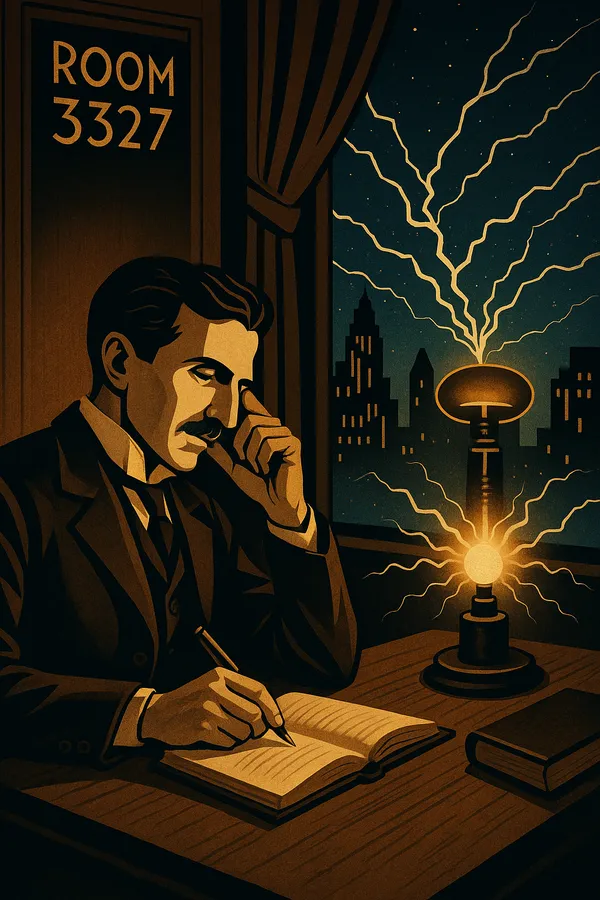
Nikola Tesla never let go of the question: if music rides the air, why not power? The story traces his early experiments at Colorado Springs and Wardenclyffe and shows how that vision echoes today in wireless charging, inductive transfer, and cautious power-beam trials