After a simple country list went sideways, I tried again with electricity market data. This time the answers improved, not because AI became perfect, but because the process around it became better.
Why Better AI Outputs Start With Better Questions
After the country-list exercise (see my previos blog), I had learned the hard way that simple questions are not always simple.
What started as a basic list of countries turned into five spreadsheet versions, two AI tools disagreeing, missing entries, naming problems, and one confidently wrong explanation. It was a useful reminder that AI can be extremely helpful, but only if you force the logic into the open.
So when I moved to the next stage, electricity market analysis, I knew I needed to change the way I worked.
This time, the question was harder. I wanted to understand how each country’s electricity sector actually operates. Not just whether it is “regulated” or “deregulated”, but what that means in practice. Who generates power? Who owns the wires? Is there a proper wholesale market? Can households choose suppliers? Can large commercial and industrial customers choose?
On paper, that sounds like another spreadsheet task. In reality, it is exactly the sort of thing that can go wrong quickly if the definitions are loose.
Enjoying this kind of practical AI reality check? Subscribe free for EnergyCrew insights, market notes and industry resources, without the jargon fog.
Subscribe free
Why “Regulated vs Deregulated” Is Too Simple for Electricity Markets
The energy industry loves simple labels. Regulated. Deregulated. Liberalised. Vertically integrated. Competitive. Unbundled.
They are useful words, but they can hide more than they reveal. A country can have private generation but no retail switching. It can have legal unbundling on paper but a state-owned group still dominating most of the system. It can allow large industrial users to contract directly while households remain with the local utility. It can talk about reform for years without the market actually operating that way today.
That last point became important. If a country is considering liberalisation, that is useful context, but it is not the same as being liberalised. For the spreadsheet, I needed the current state, not the policy ambition.
This matters commercially. A market with a liquid wholesale price behaves differently from one built around bilateral contracts. A market focused on poles and wires creates a different opportunity from one driven by price arbitrage. A market with large-user choice but no household choice needs a different read from one with full retail competition.
The first lesson from the country-list problem was already showing up again. The answer is only useful if the definition underneath it is clear.
How Clear Market Definitions Improved the AI Analysis
This time, I did not ask AI to decide whether a market was deregulated. I broke the electricity system into more useful parts.
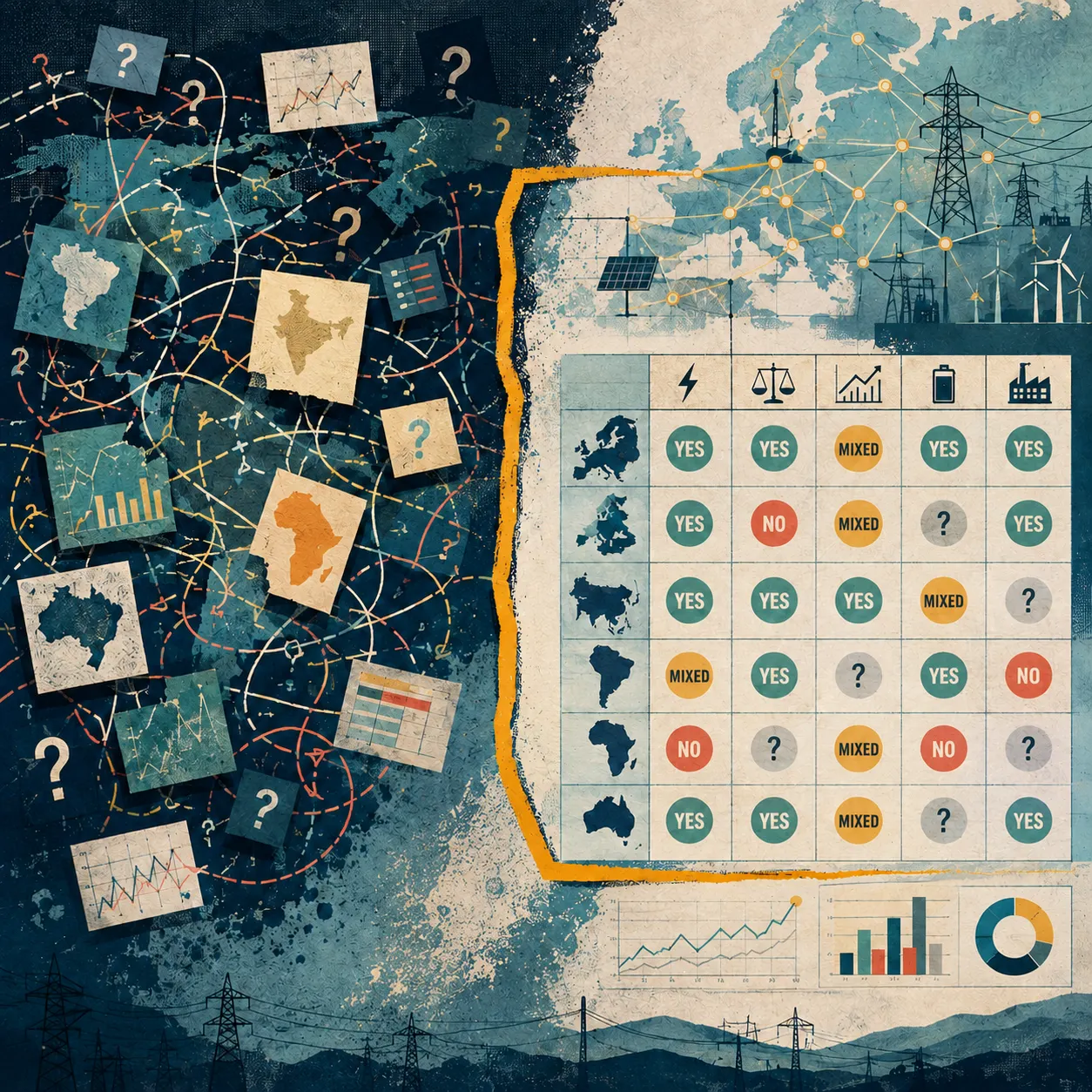
The spreadsheet looked at whether a country had a real wholesale electricity market, competitive generation, a decoupled distribution network, competitive retail supply for households, and competitive supply for commercial and industrial customers.
That sounds like detail, but the detail is the point.
A wholesale market needed to mean more than bilateral power purchase agreements or participation in a regional power pool. I wanted a proper competitive arena for bulk power, with meaningful domestic price discovery. Generation competition meant multiple producers, including independent power producers, competing to provide power. Distribution decoupling meant legal unbundling of the physical network from generation or supply. Retail competition meant household choice. Commercial and industrial competition meant large-user choice, even if households did not have the same freedom.
Suddenly, the question was no longer “is this country deregulated?”
It became: which parts of the electricity stack are actually competitive?
That is a much better question.
Why Research Beats Guesswork in AI Market Mapping
The breakthrough came when the remaining question marks were treated as research prompts, not failures.
Afghanistan was a good example. A quick answer might simply mark it as uncertain. But once you look at the structure, the picture becomes clearer. Da Afghanistan Breshna Sherkat is the state-owned utility responsible for operating and distributing electricity across the country, while Afghanistan also relies heavily on imported power and has limited domestic generation. There may be some private generation, but that does not make the overall market competitive in the way the spreadsheet needed.
Bolivia showed a different type of nuance. There are generation companies and some regional distribution structures, but the sector has also been renationalised, with ENDE playing a dominant role across generation, transmission and distribution. So the right answer is not found by grabbing one fact. You have to understand what role that fact plays in the whole structure.
Egypt was another useful case. There is private sector participation and a long-running reform agenda, but the sector remains heavily state-led, with regulated tariffs and major state ownership through EEHC and its subsidiaries. If you only read the reform language, you might overstate market openness. If you only read the state-ownership language, you might miss the direction of travel.
That was where the work got better. The question marks became a disciplined way of saying: pause, check the structure, then decide whether the evidence supports yes, no, mixed, or still unknown.
Why “Mixed” and “Unknown” Can Make AI Data More Accurate
One of the most useful decisions was allowing the spreadsheet to stay imperfect.
In the first country-list exercise, the danger was false certainty. The output looked neat before the logic had been checked. In this second round, I wanted the opposite. If the answer was genuinely unclear, I wanted the model to say so.
That meant using “?” where evidence was weak, and “Mixed” where a single yes or no would mislead.
Federal and regional markets are the obvious examples. The United States, Canada, India, Australia, Brazil and Mexico do not always fit clean national answers. Some market features exist in major regions but not everywhere. Calling the whole country yes or no can flatten the most important part of the story.
The same applied to smaller or lower-priority countries. At some point, the aim is not to create a perfect academic model of every electricity system on earth. It is to build a useful commercial map. If a country is unlikely to be a near-term target, leaving a small number of carefully marked uncertainties is better than inventing precision.
A worse spreadsheet forces everything into yes or no.
A better spreadsheet knows when the honest answer is mixed, uncertain, or not worth over-polishing yet.
What Changed Between the First AI Attempt and the Second
The biggest difference was not the AI tool. It was the operating model around it.
In round one, the country-list task started too loosely. The tools filled in the gaps in different ways. One used a sovereign-country framing. Another pulled in territories and special jurisdictions. Naming conventions then created false gaps. The issue was not only bad data. It was uncontrolled scope.
In round two, the scope was tighter from the start. The definitions were written down. Edge cases were discussed before the spreadsheet was treated as useful. The model was encouraged to be conservative. It was allowed to admit uncertainty. Most importantly, the output had to fit the logic, not the other way around.
That changed the quality of the work.
AI did not suddenly become perfect. It still needed checking. But it became much more useful once the task was framed like a system rather than a prompt.
What AI-Assisted Market Analysis Still Needs From Humans
The lesson is not that AI cannot do research. I do not believe that. If anything, this process made me more convinced that AI can be incredibly powerful for structured analysis, especially when you are trying to move quickly across a large number of countries, definitions and market structures.
But it also made me more convinced that AI needs boundaries.
If you ask a vague question, you may get a confident answer built on hidden assumptions. If you define the categories, clarify the edge cases, allow uncertainty, check examples, and challenge the first pass, the answer gets better. Not magically better, but operationally better.
This is probably the real skill emerging around AI. It is not just prompt writing. It is judgement. Knowing when to accept, when to challenge, when to add definitions, when to ask for sources, when to allow “Mixed”, and when a clean answer is actually too clean.
The first mistake was trusting the answer too quickly.
The second pass worked better because I defined the question.
Enjoyed the article?Subscribe free for EnergyCrew insights, market notes and industry resources, without the jargon fog.
Subscribe free